Table of Contents
- What Is a Trading Journal?
- Why Is a Trading Journal Important?
- 15 Benefits of Keeping a Trading Journal
- What Happens If You Don't Keep a Trading Journal?
- What Should You Record in a Trading Journal?
- How a Trading Journal Helps With Trading Psychology
- How a Trading Journal Improves Risk Management
- How to Review Your Trading Journal
- Trading Journal Example
- Trading Journal vs Simply Remembering Your Trades
- Paper Journal vs Excel vs Trading Journal Software
- How Trade Journal Desk Helps Traders
- Who Should Keep a Trading Journal?
- How to Start Today
- Frequently Asked Questions
- Final Verdict
Two traders place roughly the same number of trades this month. One closes each position and moves straight to the next chart — win or lose, the trade is over, nothing written down. The other spends two minutes after every trade recording why they entered, which strategy they used, where the stop loss sat, how much they risked, what they felt in the moment, what actually happened, and what they'd do differently next time.
Three months and roughly a hundred trades later, the difference between these two traders isn't skill. It's information. The first trader has a vague sense of "I think I'm doing okay" built on memory, which tends to remember the big wins vividly and quietly smooth over the losses. The second trader has an actual dataset — real numbers on which strategies work, which mistakes keep recurring, and where the risk is actually being taken.
That gap is the entire case for keeping a trading journal. It doesn't predict your next trade or guarantee an edge. What it does is turn a blur of individual decisions into something you can actually review, measure, and improve. As the idea goes at the center of this guide: Every Trade Tells a Story — a journal is simply how you make sure you're still able to read it three months later.
What Is a Trading Journal?
A trading journal is a structured record of every trade you take — not just the entry and exit price, but the reasoning behind the trade, the risk taken, and what happened afterward. It's the difference between a trade log (a bare list of prices and outcomes) and a complete trading journal, which also captures strategy, psychology, and lessons learned.
A trade log tells you what happened. A full trading journal tells you why it happened — and that's the part that actually changes how you trade going forward. For a deeper walkthrough of the concept itself, see the full trading journal guide, which covers the definition and fundamentals in more depth than this article will.
Why Is a Trading Journal Important?
Trading is fundamentally a decision-making process repeated hundreds or thousands of times. Every trade involves a series of choices — when to enter, how much to risk, when to exit, whether to follow the plan or deviate from it. Without a record, those decisions evaporate the moment the trade closes.
That evaporation is the real cost of skipping a journal. It's not that any single ungraded trade matters much on its own — it's that a hundred ungraded trades in a row leave you with no way to tell whether your process is actually improving, staying flat, or quietly getting worse.
A journal changes that by creating:
- Accountability — a written record of what you actually did, not what you remember doing.
- Data — real numbers to evaluate instead of a general feeling about how things are going.
- Review — a structured way to look back at decisions with a clear head, away from the pressure of a live trade.
- Pattern recognition — the ability to see recurring behavior across dozens of trades that's invisible trade-by-trade.
- Continuous improvement — a feedback loop that turns experience into something you can actually learn from, rather than just accumulate.
A trading journal is important because it replaces memory with data. Trading involves hundreds of small decisions, and without a written record, patterns in strategy performance, risk-taking, and psychology stay invisible — a journal is what makes them visible enough to actually improve.
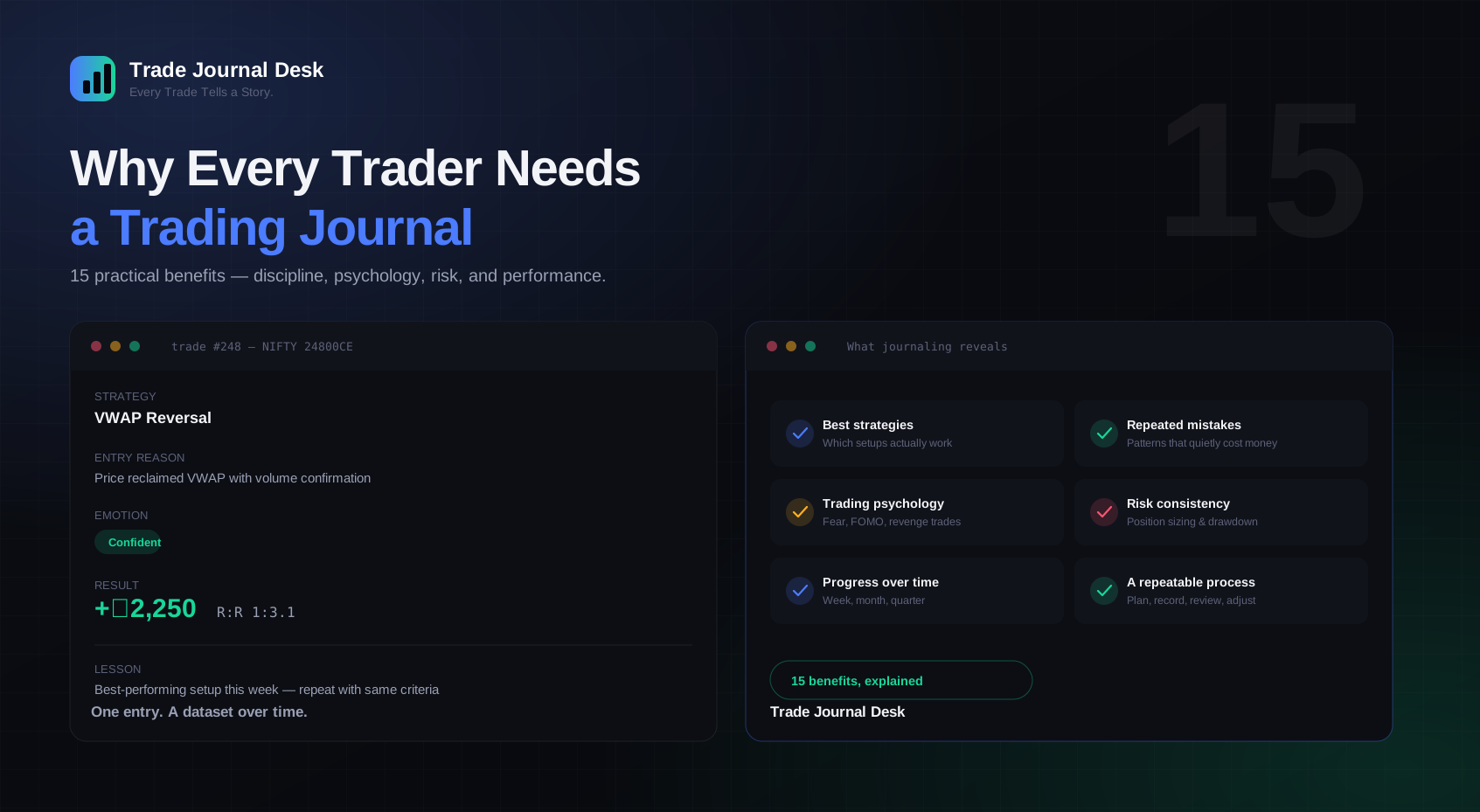
15 Benefits of Keeping a Trading Journal
These are the concrete, practical reasons traders across markets — crypto, forex, stocks, futures, and options — keep a journal. None of them involve predicting the market. All of them involve understanding your own trading better.
1. Understand Your Trading Performance
Memory is selective. Most traders can vividly recall their biggest win of the month and conveniently forget three smaller losses that happened the same week. A journal replaces that selective memory with an actual record — real win rate, real average PnL, real numbers instead of a general impression of "doing alright."
This matters more than it sounds. A trader who believes they're "roughly breaking even" but is actually down for the month will keep trading the same way, because nothing has told them otherwise. A trader who checks the actual numbers each week catches that gap early enough to do something about it.
2. Identify Your Best Strategies
If you trade more than one setup — say, breakouts and pullbacks — a journal lets you compare them side by side using real data: win rate, average R:R, and net contribution to your PnL. Without that breakdown, it's easy to keep trading a setup you feel is working when the numbers actually say otherwise.
3. Identify Repeated Mistakes
Certain mistakes tend to show up again and again once you start looking: entering too early before confirmation, moving a stop loss further away mid-trade, taking profit too early out of nervousness, revenge trading after a loss, or overtrading out of boredom. A journal turns these from a vague suspicion into a countable, specific pattern.
4. Improve Trading Discipline
Writing down every rule violation — even small ones — creates a kind of accountability that's hard to get any other way. It's one thing to know, abstractly, that you shouldn't move your stop loss. It's another to see it logged eleven times in the last two months, next to the PnL impact each time.
5. Understand Trading Psychology
Fear, greed, FOMO, revenge, overconfidence, and impatience all show up in real trading decisions, whether or not a trader consciously notices them in the moment. Tagging trades with the emotional state behind them makes it possible to see, after the fact, which feelings tend to precede your worst trades.
6. Improve Risk Management
Tracking risk per trade, position size, stop-loss placement, R:R, and drawdown across your full trade history shows whether your risk management is actually consistent — or whether it quietly loosens after a winning streak and tightens up defensively after a losing one.
Most traders assume their risk-taking is fairly steady. In practice, a review often shows the opposite: bigger position sizes right after a big win, and unusually cautious sizing right after a loss — the two moments where consistent risk actually matters most.
7. Discover Which Markets Suit You
Crypto, forex, stocks, commodities, futures, and options all behave differently — different volatility, different session structures, different costs. A journal that spans multiple markets can show you, in your own data, which one you actually perform best in, rather than which one simply gets the most of your attention.
8. Find Your Most Profitable Trading Times
Breaking trades down by time of day or market session — morning, afternoon, evening, or by session (Asian, London, New York) — can reveal whether your results cluster around a particular window. This varies enormously by trader and strategy; there's no universally "best" session, only the one your own data points to.
9. Separate Skill From Luck
A handful of winning trades can happen by chance even with a flawed strategy, and a handful of losing trades can happen even with a sound one. A journal spanning dozens or hundreds of trades is what lets you tell the difference — a small sample proves very little either way.
Five winning trades in a row feels like proof a strategy works. It might be — or it might just be five favorable outcomes on a setup with a genuine edge closer to a coin flip. The only way to know which is true is a large enough sample, and a journal is what accumulates one without you having to remember every trade along the way.
10. Improve Trade Selection
Reviewing your full trade history periodically often surfaces setups that, in hindsight, should have been skipped — trades taken outside your normal criteria, in an unclear market, or simply out of impatience. Recognizing that pattern is the first step to filtering it out going forward.
11. Reduce Emotional Decision-Making
Pre-defining your entry, stop, and target before a trade — and then reviewing afterward whether you actually followed that plan — creates a structure that leaves less room for in-the-moment emotional decisions. The review step is what closes the loop; the plan alone isn't enough.
12. Measure Progress
Comparing performance week over week, month over month, and quarter over quarter shows a trajectory that a single day or week never can. Progress in trading is rarely a straight line, and a journal is what makes the underlying trend visible through the noise.
13. Build Confidence Through Evidence
There's a real difference between confidence that comes from a feeling ("I'm good at this") and confidence that comes from documented performance ("here are 200 trades and what they show"). The second kind holds up under pressure in a way the first often doesn't.
The practical effect shows up during a losing streak. A trader relying on a feeling of confidence tends to second-guess everything the moment results turn. A trader who can point to 200 documented trades showing a strategy's real historical win rate has something concrete to check the current streak against — is this normal variance, or has something actually changed?
14. Learn From Losing Trades
A losing trade that was well-planned, properly sized, and executed according to plan is fundamentally different from a losing trade caused by a rule violation — and a journal is what lets you tell them apart. Both are worth reviewing, but only one usually points to something that needs to change.
15. Create a Repeatable Trading Process
Individually, journaling one trade doesn't change much. Done consistently, it becomes part of a full trading routine — plan, execute, record, review, adjust — that turns trading from a series of disconnected decisions into an actual process you can refine over time.
What Happens If You Don't Keep a Trading Journal?
Skipping a journal doesn't lead to a dramatic failure — it's rarely that obvious. What actually happens is quieter and slower: small inefficiencies that never get corrected because nothing ever surfaces them clearly enough to notice. None of this is exaggerated or dramatic — it's simply what tends to happen by default when trades aren't recorded:
- The same mistakes repeat, because nothing forces them into view.
- The specific reasoning behind a trade gets forgotten within days.
- Performance tends to get overestimated, since wins are easier to recall than losses.
- Losses tend to get underestimated for the same reason, in reverse.
- It stays unclear which strategies are actually working.
- Decisions lean more emotional, without a record to check them against.
- Risk control tends to drift, since there's nothing tracking it consistently.
- There's no real accountability — no evidence to hold your own decisions against.
None of these are permanent flaws in a trader — they're simply the default outcome of relying on memory for something memory isn't built to hold accurately.
What Should You Record in a Trading Journal?
| Field | What to Record | Why It Matters |
|---|---|---|
| Date & Time | When the trade was opened | Reveals time-of-day and day-of-week patterns |
| Market | Crypto, forex, stocks, futures, options | Keeps performance comparisons meaningful across markets |
| Symbol | The specific instrument traded | Shows which instruments you actually perform well on |
| Strategy | The setup used to enter | The single most useful field for evaluating what works |
| Side | Long or short | Reveals any directional bias in your results |
| Entry & Exit | The actual prices traded | The raw inputs behind every other calculation |
| Quantity | Position size | Converts price movement into real PnL |
| Stop Loss & Take Profit | Your planned exits | Compares the plan against what actually happened |
| Risk & Reward | Distance to stop and target | The basis for R:R and position-sizing discipline |
| R:R | Reward divided by risk | Shows whether your wins are structurally larger than your losses |
| Gross PnL & Fees | Raw profit/loss and trading costs | Separates trading performance from the cost of trading |
| Net PnL | What you actually made or lost | The number that matters after every cost is accounted for |
| Screenshot | A chart image at entry and exit | Context that raw numbers alone can't fully capture |
| Emotion | Your state of mind during the trade | Surfaces psychological patterns tied to outcomes |
| Mistake | Any rule violation or error | The fastest way to find your most expensive recurring error |
| Notes | Freeform context | Captures nuance that structured fields can't |
| Tags | Custom labels for filtering later | Makes pattern-finding across trades possible |
For a ready-to-use structure covering these exact fields, see the full trading journal template — it walks through each field in more depth, including a sample layout you can copy directly.
How a Trading Journal Helps With Trading Psychology
Most trading mistakes trace back to a handful of familiar emotional patterns:
- Fear — exiting winning trades too early, or hesitating on valid setups.
- Greed — holding trades past the original target, hoping for more.
- FOMO — entering a trade late, chasing a move that's already happened.
- Revenge trading — trying to immediately win back a loss with an unplanned trade.
- Overtrading — taking trades out of boredom or restlessness, not an actual setup.
- Overconfidence — increasing size or dropping risk controls after a winning streak.
- Impatience — exiting a valid setup early because waiting felt uncomfortable.
None of these are unusual or a sign of a "bad trader" — they're common, well-documented patterns in how people make decisions under uncertainty. What a journal does is make them visible: tagging each trade with the emotional state behind it, then filtering by tag later, turns "I think I do this sometimes" into "this happened in 14 of my last 60 trades, and it cost me on average X."
A trading journal is not a substitute for professional mental health support. It's a tool for spotting behavioral patterns in your trading decisions — not a form of therapy or psychological treatment.
How a Trading Journal Improves Risk Management
Risk management sounds simple in theory and tends to drift in practice. A journal makes that drift visible by tracking:
- Risk per trade — the actual dollar or percentage amount risked, trade by trade.
- Position sizing — whether size stays consistent with your stated risk tolerance.
- Stop-loss discipline — whether stops are honored or moved once a trade is live.
- R:R — whether your reward targets are structurally larger than your risk, on average.
- Drawdown — the size and duration of your worst losing stretches.
- Losing streaks — how many consecutive losses tend to happen, and how you respond to them.
- Maximum daily loss — whether a self-imposed daily stop is actually being respected.
A simple example: if a trader risks 1% of their account per trade but the journal shows several trades risking 3–4% during a losing streak — sized up in an attempt to "win it back" — that's a concrete, specific problem to fix, rather than a vague sense that "risk management could be better."
Drawdown is worth tracking the same way. A trader who knows their historical maximum drawdown is, say, 12% over a bad month has a real benchmark to compare a current rough patch against. Without that number, every losing streak feels like it could be the start of something worse than it usually turns out to be — and that uncertainty is often what pushes traders into exactly the oversized, emotional trades that make a drawdown deeper than it needed to be.
How to Review Your Trading Journal
A journal only pays off if it's actually reviewed on a consistent rhythm. Here's a practical structure:
After every trade
Record the trade while it's fresh — entry, exit, strategy, risk, emotion, and a quick note on what happened. This takes two or three minutes and is the single habit the rest of the process depends on.
Daily
A short end-of-day scan for any major mistakes or rule violations — nothing deep, just enough to catch an obvious pattern before it repeats the next session.
Weekly
A deeper look at win rate, net PnL, average R:R, strategy-level performance, and any mistakes that showed up more than once. This is usually where the first real patterns become visible.
Monthly
A full review: best and worst strategy, best and worst symbol, maximum drawdown, psychological patterns across the month, and an honest look at overall consistency.
For a more detailed walkthrough of building this habit day to day, see how to keep a trading journal — it covers the full workflow this section only summarizes.
Trading Journal Example
The table below is a fictional example — illustrative only, not real trading results or a performance claim.
| Date | Symbol | Strategy | Side | Entry | Exit | Qty | Net PnL | R:R | Emotion | Mistake | Lesson |
|---|---|---|---|---|---|---|---|---|---|---|---|
| 03 Aug | BTCUSDT | Breakout | Long | 61,200 | 63,100 | 0.02 | +₹3,180 | 1:2.6 | Calm | None | Setup followed exactly as planned |
| 05 Aug | EURUSD | Pullback | Short | 1.0850 | 1.0875 | 1 lot | −₹2,050 | 1:1.5 | Impatient | Entered early | Wait for full confirmation next time |
| 07 Aug | NIFTY 24800CE | VWAP Reversal | Long | 145 | 190 | 50 | +₹2,250 | 1:3.1 | Confident | None | Best-performing setup this week |
| 09 Aug | XAUUSD | NY Killzone | Short | 2,415 | 2,428 | 0.5 lot | −₹650 | 1:1.8 | Revenge | Oversized after prior loss | Skip trading immediately after a loss |
| 11 Aug | ETHUSDT | EMA Crossover | Long | 3,400 | 3,520 | 0.3 | +₹1,140 | 1:2.0 | Calm | None | Consistent with plan and average R:R |
Trading Journal vs Simply Remembering Your Trades
Memory feels reliable in the moment and tends not to be, especially once dozens of trades are involved. Here's how the common alternatives compare:
| Method | Accuracy | Searchable | Shows Patterns |
|---|---|---|---|
| Memory alone | Low — biased toward big wins | No | No |
| Rough notes | Moderate — depends on consistency | Limited | Limited |
| Excel / Google Sheets | High, if formulas are correct | Yes, manually | Yes, with manual work |
| Dedicated trading journal software | High, calculated automatically | Yes, built in | Yes, built in |
The gap between "memory" and any written method is the biggest jump on this table by far — the difference between the written methods themselves is mostly about how much manual work stands between logging a trade and actually seeing a pattern in it. Even a barebones written record beats no record at all; the real question is how much friction stands between you and reviewing it regularly.
Paper Journal vs Excel vs Trading Journal Software
| Feature | Paper Journal | Excel / Sheets | Trading Journal Software |
|---|---|---|---|
| Cost | Free | Free or low-cost | Free to start, paid tiers |
| Ease of entry | Simple, but slow | Moderate | Fast, structured form |
| Analytics | None | Manual, if built | Built in |
| Automation | None | Low, unless scripted | High |
| Screenshots | Not practical | Stored separately | Attached to the trade |
| Psychology tracking | Freeform only | Freeform column only | Structured fields |
| Strategy analysis | Manual tally | Manual pivot tables | Built-in dashboards |
| Risk analysis | Manual | Manual formulas | Automatic |
| Reports | None | Manual construction | Generated automatically |
| Search | Not practical | Basic filters | Purpose-built search |
| Mobile access | Physical only | Limited, fiddly | Usually built for mobile |
| Cloud access | None | With extra setup | Native |
A deeper look at the middle two columns — including exact PnL formulas and when a spreadsheet starts to strain — is covered in Excel vs trading journal software. The short version: paper works for a habit-building phase, spreadsheets work well at low volume, and dedicated trading journal software tends to matter most once trade count and strategy count both grow.
How Trade Journal Desk Helps Traders
Trade Journal Desk is built to turn the kind of tracking described throughout this article into something that takes minutes, not hours, per week. It includes:
- A structured trade journal with automated PnL calculation
- Automatic risk and R:R tracking
- Strategy-level performance tracking
- Performance analytics dashboards
- A trading calendar view
- Screenshots attached directly to trades
- Structured psychology tracking
- Structured mistake tracking
- Built-in performance reports
- A dark theme with a responsive interface
- Support for crypto, forex, commodities, Indian stocks, and futures & options
- Multi-currency support
The goal isn't to replace your own judgment as a trader — it's to make sure every trade you take actually contributes to a dataset you can learn from, instead of disappearing the moment the position closes. Every Trade Tells a Story — Trade Journal Desk is built to help you actually read it.
Who Should Keep a Trading Journal?
Practically every kind of trader benefits from journaling, though the specific value shifts by style:
- Beginners — building the habit early, before bad patterns have time to set in.
- Day traders and scalpers — high trade frequency makes patterns statistically visible faster.
- Swing traders — fewer trades makes each one worth reviewing in more depth.
- Crypto traders — 24/7 markets make session and time-of-day analysis especially useful.
- Forex traders — comparing performance across different sessions and pairs.
- Stock traders — separating sector or symbol-specific performance from overall results.
- Commodity, futures, and options traders — tracking the extra variables (expiry, contract size, margin) that come with these instruments.
The instruments differ, but the underlying discipline doesn't — every one of these trading styles benefits from the same core habit of recording the decision, not just the outcome. What changes from style to style is mainly which fields matter most: a scalper cares more about time-of-day patterns across dozens of daily trades, while a swing trader gets more value out of deep notes on a handful of setups per week.
If you're still deciding what kind of journal fits your style best, choosing a trading journal as a beginner walks through the must-have features and common early mistakes in more detail.
How to Start Today
Choose your journal
Paper, spreadsheet, or dedicated software — pick whichever you'll actually use consistently. The best journal is the one that gets filled in.
Define what you want to track
Start with the core fields — date, symbol, strategy, side, entry, exit, risk, R:R — and add more only once the basics are a habit.
Record every trade
Not just the wins, and not just the ones you feel like reviewing. Every trade belongs in the dataset.
Add screenshots and emotions
These are the two fields most traders skip first — and usually the two that reveal the most once you start reviewing.
Review weekly
Win rate, net PnL, R:R, and any mistake that showed up more than once.
Review monthly
Best and worst strategy, best and worst symbol, drawdown, and overall consistency.
Turn observations into specific changes
A pattern is only useful once it becomes a concrete rule — "stop trading after two consecutive losses" is more actionable than "I should manage my emotions better."
Frequently Asked Questions
Why is a trading journal important?
It replaces memory — which is selective and tends to overweight big wins — with an actual, reviewable record of every trade, making it possible to see real patterns in strategy performance, risk-taking, and psychology.
Is a trading journal worth it?
For traders who want to understand their own performance rather than guess at it, yes. It doesn't guarantee better results, but it turns vague impressions into evidence you can actually check.
Do beginner traders need a journal?
Especially beginners — starting the habit early means patterns and mistakes get caught before they become deeply ingrained.
What should I record in a trading journal?
At minimum: date, symbol, strategy, side, entry, exit, quantity, stop loss, take profit, PnL, and notes. A complete journal also tracks R:R, fees, screenshots, emotion, mistakes, and tags.
Should I journal losing trades?
Yes — losing trades, especially well-planned ones that simply didn't work out, often carry more useful information than winning trades do.
How often should I review my journal?
A quick check after every trade, a short daily scan, a deeper weekly review, and a full monthly review is a practical, sustainable rhythm for most traders.
Can a trading journal improve discipline?
Yes. Recording rule violations — even small ones — creates a form of accountability that's difficult to maintain through willpower alone.
Can a trading journal help with psychology?
It can help surface recurring emotional patterns like fear, FOMO, or revenge trading by tagging trades with the emotional state behind them. It's not a substitute for professional mental health support.
Can I use Excel as a trading journal?
Yes — Excel and Google Sheets are common starting points, fully customizable and free, though formulas and analytics have to be built and maintained manually. See Excel vs trading journal software for a full comparison.
What is the best trading journal?
The one that fits your actual workflow and that you'll use consistently. Look for automated calculations, strategy and risk analytics, and psychology tracking if you want more than a basic log.
What is a digital trading journal?
A digital trading journal is software — as opposed to paper — used to record and analyze trades, typically with automated calculations and built-in analytics that a paper journal can't provide.
Can I journal crypto trades?
Yes. Crypto trades fit the same core fields as any other market, with the option to add fields like funding rate for perpetual futures.
Can I journal forex trades?
Yes. Forex journaling typically uses the same structure, often with pip-based risk and reward alongside or instead of raw price values.
Can I journal Indian stocks?
Yes. Indian equity and derivatives trades fit the same journal structure, usually with brokerage and statutory charges tracked separately to arrive at accurate net PnL.
Can I track options trades?
Yes, though options often benefit from a few extra fields — strike price, expiry, and lot size — beyond the basic spot-trading template.
What trading metrics should I track?
Win rate, average R:R, net PnL, maximum drawdown, and performance broken down by strategy and symbol are the core metrics most traders find useful to track consistently.
Should I record emotions?
Yes. Emotion is one of the highest-value fields in a trading journal — cross-referenced against outcomes, it's often where a trader's most expensive recurring mistake becomes visible.
Should I take screenshots of trades?
It's strongly recommended. A screenshot preserves what the chart actually looked like at entry — memory tends to "clean up" the setup in hindsight.
How do I analyze my trading journal?
Start with win rate, average R:R, and net PnL, then break each down by strategy, symbol, and time period. Weekly and monthly reviews are where most useful patterns become visible.
Is Trade Journal Desk free?
Yes — the Free plan includes 10 trades with no time limit and no card required. Paid plans start at ₹49 for 30 days.
Final Verdict
A trading journal isn't about predicting your next trade. It's about understanding the trades you've already taken — clearly enough to actually learn something from them.
Kept consistently, a journal can help surface patterns, recurring mistakes, real strengths, real weaknesses, risk problems, and psychological habits that are otherwise nearly impossible to see from inside a single trade. None of that guarantees profitability — trading involves risk, and no record-keeping tool changes that. What it does is replace guesswork about your own performance with evidence.
The trader who journals consistently isn't necessarily the trader who wins the most. They're the trader who knows, with real data behind it, exactly what's working, what isn't, and what to change next — which over time tends to matter more than any single trade ever could.
Trade Journal Desk is a trading journal and analytics tool. It does not provide investment advice, trading signals, or guarantees of profit. Trading involves risk.
Ready to learn more from every trade? Start journaling with Trade Journal Desk and turn your trading history into meaningful insights — 10 free trades, no payment required to start.
Every Trade Tells a Story.
Keep Exploring
Ready to understand your trading like never before?
Start using Trade Journal Desk and discover why Every Trade Tells a Story.