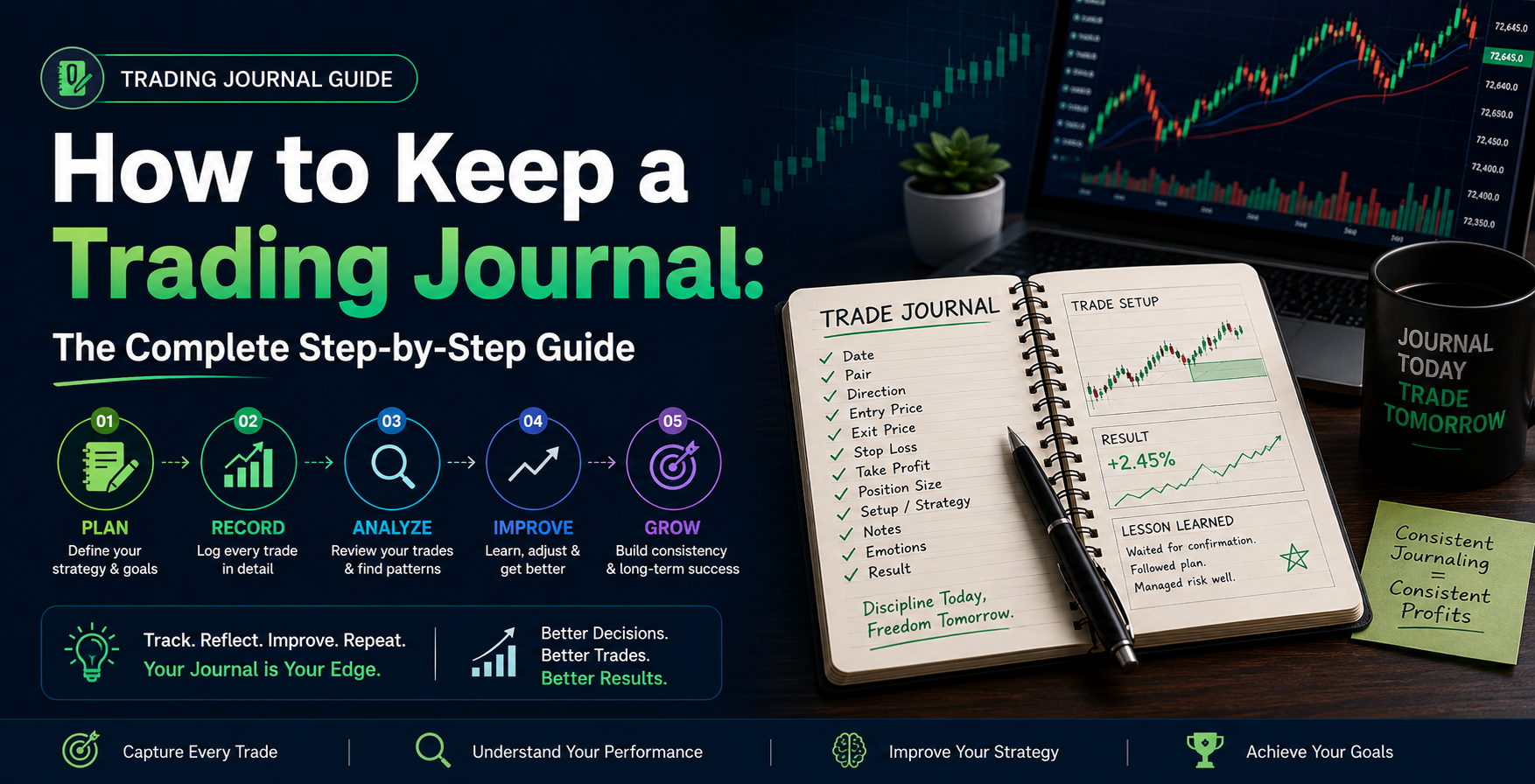
Most traders remember only their winning trades. Ask someone about the best trade of their month and they'll describe it in vivid detail — the setup, the feeling, the exact moment they knew it would work. Ask about a losing trade from three weeks ago and you'll usually get a shrug.
Very few traders can actually answer the questions that matter: why they entered, why they exited, what they felt in the moment, and what specific mistake — if any — was behind the result. Without answers to those questions written down somewhere, the same mistakes get to repeat themselves indefinitely, because there's nothing forcing them into the light.
That's the entire case for keeping a trading journal. Not as a nice-to-have habit, but as the mechanism that turns screen time into skill. This guide assumes you already know what a trading journal is — if you need that foundation first, our complete guide to trading journals covers it. This one is about how to actually keep one: what to record, when to record it, how to review it, and the habits that separate traders who improve from traders who just accumulate screen time.
- Recording a trade and reviewing it are two different habits — most traders only ever do the first one.
- A journal entry should take under a minute; anything slower gets skipped on busy days.
- Weekly and monthly reviews matter more than daily logging — logging without reviewing is just a diary.
- Rate your discipline separately from your outcome. A disciplined loss is not a mistake.
What Does It Mean to Keep a Trading Journal?
Keeping a trading journal means maintaining an ongoing, structured record of every trade you take — and, just as importantly, actually reviewing that record on a schedule. The word "keep" is doing real work here: a journal isn't something you fill out once and forget, it's something you keep, the same way you'd keep a ledger or a logbook — continuously, deliberately, for as long as you're trading.
The purpose is straightforward: turn your own trading history into a dataset you can learn from, instead of a blur you can only vaguely recall. The benefits follow directly from that — better decisions, fewer repeated mistakes, real numbers behind your confidence instead of vibes, and an early warning system for when a strategy stops working.
The distinction that trips people up most is the one between recording and reviewing. Recording is data entry — writing down what happened while it's fresh. Reviewing is where the actual improvement lives — going back over that data to find patterns, confirm what's working, and catch what isn't. A trader who logs two hundred trades and never once reviews them has built an impressively detailed diary and gained nothing from it. The recording is necessary. The reviewing is the point.
Why Keeping a Trading Journal Matters
Every reason to keep a trading journal traces back to one of seven things:
Learning
A logged trade is a lesson you can actually revisit. Without the log, the lesson exists for as long as your memory holds it — usually a few days, sometimes a few hours.
Improvement
You can't improve what you can't see. A journal is what makes your own patterns — good and bad — visible enough to act on.
Consistency
Markets change, and strategies that worked six months ago can quietly stop working. A journal is usually the first place that decay becomes visible, well before it shows up as a string of losses.
Confidence
Confidence built on a logged track record is sturdier than confidence built on your last few trades. One is data; the other is recency bias wearing a disguise.
Risk
Risk per trade, daily loss limits, position sizing — all of these stay theoretical until a journal shows you, in real numbers, whether you're actually following them.
Discipline
Simply knowing you'll have to log a trade — and explain your reasoning for it — makes impulsive entries less tempting. It's accountability that works even when nobody else is watching.
Psychology
Fear, greed, FOMO, and revenge trading are far easier to spot in a log of fifty trades than in the heat of any single one. A journal is what turns "I think I do this sometimes" into a specific, fixable pattern.
What Information Should You Record?
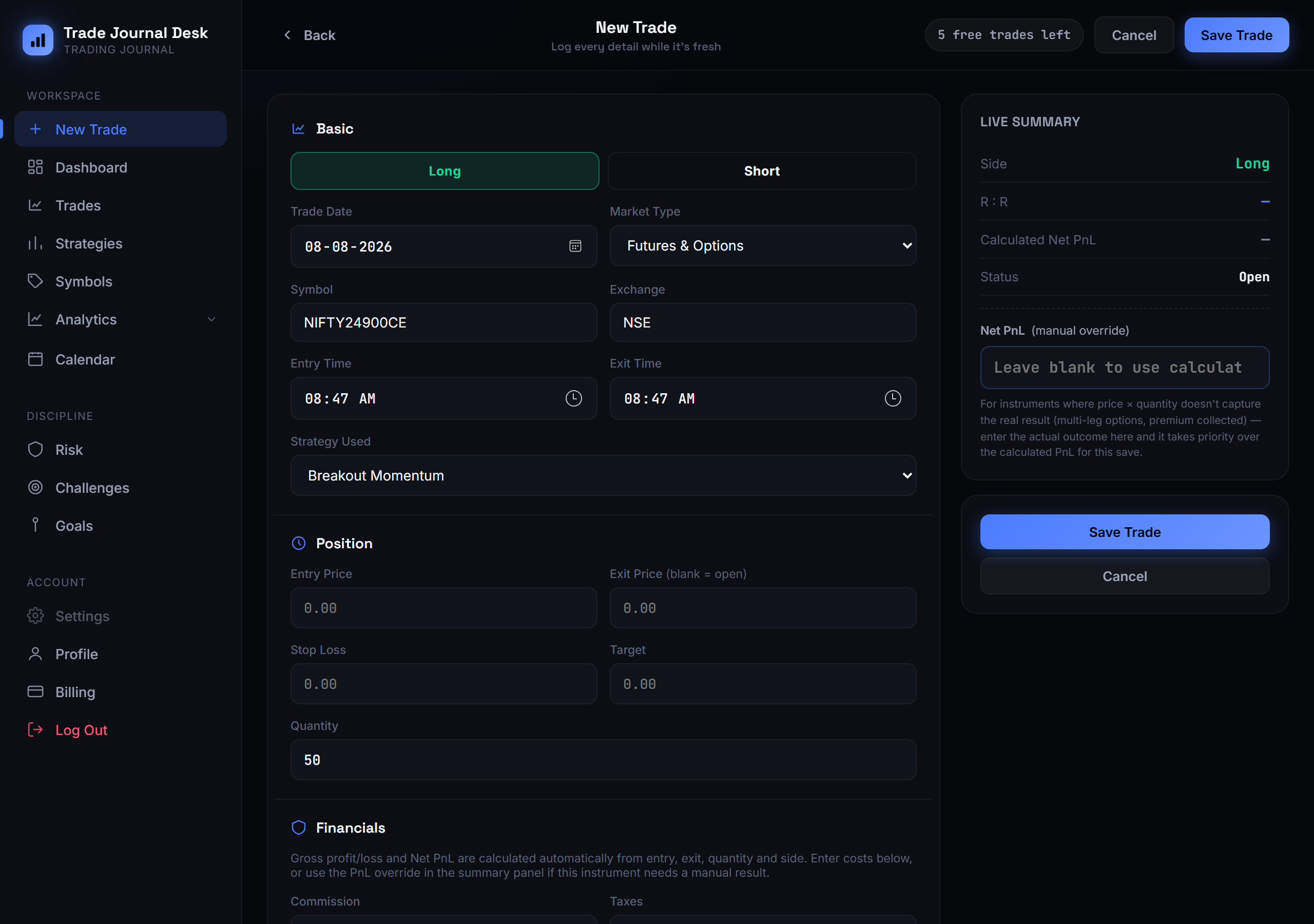
Here's the full field list worth tracking. Not every field needs to be filled in on day one — start with the "critical" ones and add the rest as the habit solidifies.
| Field | What It Captures | Priority |
|---|---|---|
| Date | The calendar date of the trade | Critical |
| Time | Entry and exit time | High |
| Market | Crypto, forex, stocks, commodities, F&O | Critical |
| Symbol | The exact instrument traded | Critical |
| Long/Short | Direction of the trade | Critical |
| Entry Price | Price at which you entered | Critical |
| Exit Price | Price at which you exited | Critical |
| Quantity | Position size / lot size | Critical |
| Leverage | Margin multiplier, where applicable | Medium |
| Stop Loss | The price that proves the idea wrong | Critical |
| Take Profit | Your planned exit target | High |
| Risk | Amount you stood to lose | High |
| Reward | Amount you stood to gain | High |
| Net PnL | Actual profit or loss after costs | Critical |
| Fees | Commission, taxes, funding, slippage | Medium |
| Screenshots | Chart image at entry, and ideally at exit | High |
| Emotion | How you felt before and after | Medium |
| Mistakes | Tagged errors — moved stop, oversized, chased entry | High |
| Strategy | Which playbook or setup you executed | High |
| Notes | Reasoning, context, lessons | Medium |
| Tags | Custom labels for later filtering | Nice-to-have |
If you're overwhelmed by this list, start with just nine fields: date, symbol, direction, entry, exit, quantity, stop loss, strategy, and net PnL. That's enough to calculate a real win rate and risk-reward ratio. Add emotion, mistakes, and screenshots once logging those nine feels automatic.
Step-by-Step Process
Here's the actual workflow, broken into nine steps — from planning the trade to reviewing it a month later.
Plan the trade
Before entering, write down your setup, entry trigger, stop loss, and target. This is the plan you'll grade yourself against later — without it, "discipline" has nothing to measure against.
Take a screenshot
Capture the chart the moment you enter. This single habit prevents the single most common distortion in trading memory — misremembering what the setup actually looked like.
Record the entry
Log symbol, market, direction, entry price, quantity, stop loss, target, and strategy immediately. Waiting until later means details get fuzzy or skipped entirely.
Manage the trade
If you adjust your stop, scale in or out, or change your plan mid-trade, note it. These mid-trade decisions are often more revealing than the entry or exit alone.
Record the exit
Log exit price and time the moment you close the position. Net PnL, risk-reward, and win/loss status should calculate themselves from here — you shouldn't be doing this math by hand.
Write notes
One or two honest sentences: what you expected, what happened, what you'd do differently. Skip generic notes like "good trade" — they teach you nothing on review.
Rate your discipline
Separately from the outcome, grade your execution — did you follow the plan, respect the stop, size correctly? A well-executed loss is not a mistake. An undisciplined win is still a mistake, even though it paid off.
Weekly review
Once a week, go through every trade with its screenshots. Tally wins and losses by strategy, and identify the one pattern worth addressing next week.
Monthly review
Once a month, step back to the metrics level — win rate, profit factor, average risk-reward, and your most expensive recurring mistake. This is where strategy-level decisions actually get made.
How Professional Traders Journal
Walk onto almost any proprietary trading desk and the review cadence looks remarkably similar from trader to trader:
- Daily — a short end-of-day check: did today's trades follow the plan, and did anything break a risk rule?
- Weekly — a proper sit-down review of every trade, screenshots included, usually with a mentor or peer involved.
- Monthly — a metrics-level review: win rate, profit factor, expectancy, and drawdown, compared against the previous month.
- Quarterly — a step back to ask whether the overall strategy still fits current market conditions, not just whether individual trades worked.
- Performance reviews — for funded and prop traders, this cadence often feeds directly into whether capital allocation increases, stays flat, or gets pulled back.
None of this requires an institutional setup. It requires the schedule, applied consistently, with the same fields logged the same way every time.
Common Journaling Mistakes
Never reviewing. Logging trades without ever looking back at them. The habit feels productive but delivers nothing on its own.
Only recording winners. It's tempting to skip the trades that didn't work. It also guarantees your journal lies to you about your real win rate.
Ignoring emotions. Treating trading as purely mechanical skips the exact area where many of the worst losses actually originate.
Ignoring screenshots. Without a visual record, you'll misremember the setup — almost always in a way flattering to the original decision.
Ignoring risk. Logging entries and exits without ever checking risk per trade against your actual limits.
No strategy tracking. If trades aren't tagged to a strategy, you can never answer "which of my setups actually works" — only "am I up or down."
Paper Journal vs Excel vs Software
| Capability | Notebook | Excel | Trade Journal Desk |
|---|---|---|---|
| Speed to log a trade | Slow, manual | Slow, formula upkeep | ✓ Under a minute |
| Analytics | None | DIY pivot tables | ✓ Built-in |
| Cloud backup | None | If saved to cloud storage | ✓ Always on |
| Reports | Manual | Manual | ✓ Generated |
| Calendar view | None | DIY conditional formatting | ✓ Built-in |
| Screenshots | Not possible | Clunky | ✓ Native |
| Psychology tracking | Free-form | DIY columns | ✓ Structured & charted |
| Review workflow | Forces reflection | No structure enforced | ✓ Structured & fast |
A notebook's one real strength is that writing by hand slows you down and forces genuine reflection — it's a perfectly reasonable place to start. Excel is a fine middle step. Both hit a wall the moment you want real analytics without spending your evenings maintaining formulas instead of actually reviewing trades.
Weekly Trading Review Checklist
Twenty to forty minutes, same day every week:
- Win rate — for the week, and by strategy if you traded more than one.
- Average risk-reward — did your actual trades match your planned ratios?
- Mistakes — which tagged errors showed up more than once this week?
- Emotions — any trades tagged FOMO, revenge, or anxious — and what triggered them?
- Best strategy — which setup performed strongest this week?
- Worst strategy — which one is quietly dragging results down?
Monthly Trading Review Checklist
About an hour, once a month:
- Review win rate, profit factor, and expectancy for the full month.
- Compare every strategy you traded against each other — which deserves more size, which deserves less?
- Identify your single most expensive recurring mistake, and write one concrete rule to fix it.
- Confirm your risk limits — daily, weekly, monthly — were actually respected, not just set.
- Check your equity curve and maximum drawdown against the previous month.
- Set one specific, measurable goal for next month — not "trade better," something you can actually check.
Trading Journal Best Practices
- Consistency — log every trade, the same fields, every time. A journal with gaps is a journal you can't fully trust.
- Honesty — write down the trade you actually took, not the trade you meant to take. The gap between the two is often the whole lesson.
- Discipline — treat the review schedule as non-negotiable as the trading itself.
- Review — recording without reviewing is the single most common way journaling habits quietly stop paying off.
- Tagging — strategy, mistake, and emotion tags are what make a large journal searchable instead of just long.
- Screenshots — a chart image at entry is worth more than a paragraph of description written from memory.
- Risk — log risk per trade every time, even when it feels obvious. The pattern only becomes visible in aggregate.
How Trade Journal Desk Makes Journaling Easier
Everything in this guide works with a notebook or a spreadsheet. It's also, unsurprisingly, exactly the workflow Trade Journal Desk was built to support — so it's worth being direct about how the pieces fit together.
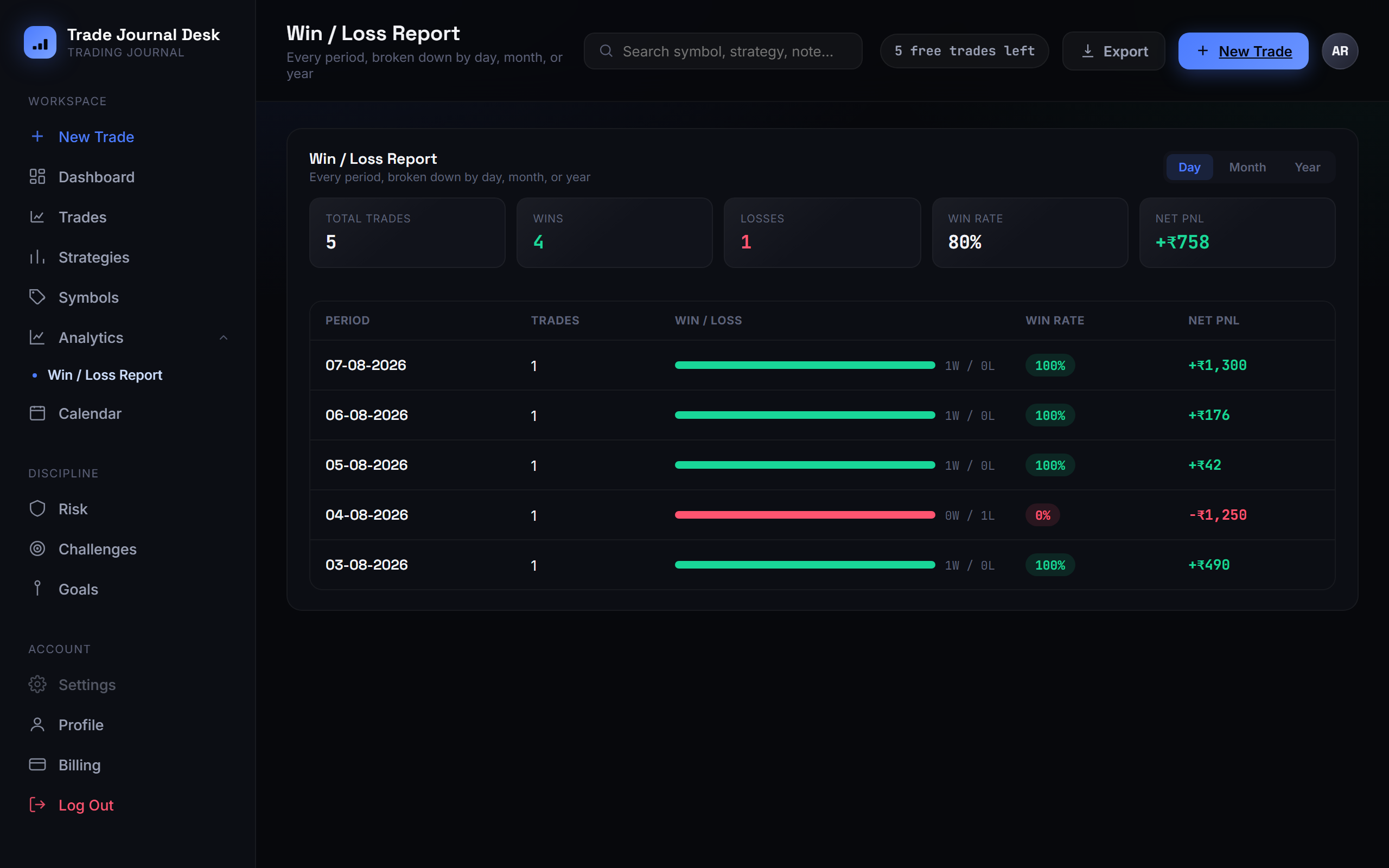
The dashboard gives you the at-a-glance numbers this guide keeps referencing — total PnL, win rate, active trades — the moment you log in. Trade logging calculates net PnL, risk, and risk-reward automatically from entry, exit, quantity, and side, so step 5 above (record the exit) never involves manual math. Analytics covers the metrics from your monthly review — profit factor, expectancy, equity curve, drawdown — built from your logged trades without a single formula to maintain.
The calendar view lays out daily PnL exactly the way a weekly review needs it. Performance reports are exportable for your own records or tax season. Psychology tracking covers step 6 and 7 — emotion tags and win rate broken down by how you felt going in. Mistakes get tagged per trade and aggregated so recurring errors surface on their own instead of staying a vague suspicion. Risk settings enforce the limits from your monthly checklist against your real trades, in real time. Strategy analytics handles the strategy comparison your monthly review calls for. And the whole thing runs in a dark theme, fully responsive on desktop or phone, because step 3 (record the entry immediately) only sticks if logging a trade from your phone is actually pleasant to do.
None of it replaces the discipline this guide describes — that part is still yours to build. What it removes is the friction between knowing you should log a trade and actually doing it. Every trade tells a story; the tool's only job is making sure that story is easy to write down and easy to read back.
The process matters more than the tool. Nine fields, nine steps, and a weekly and monthly review — that's the whole system. Software just removes the friction of running it every single day.
Frequently Asked Questions
How do I start keeping a trading journal?
Pick a small set of fields you'll log for every trade — date, symbol, entry, exit, size, strategy, and outcome — and log your very next trade before you do anything else. Starting simple and staying consistent beats a complicated system you abandon in a week.
What should I record for every trade?
At minimum: date, market, symbol, direction, entry and exit price, quantity, stop loss, target, fees, and net PnL. Add screenshots, emotion, mistakes, strategy, and notes once the basic habit is solid.
How often should I update my trading journal?
Log each trade immediately after closing it, while the details are still fresh. Review daily in a couple of minutes, weekly in more depth, and monthly at the metrics level.
Should I journal even small or quick trades?
Yes. Small trades still carry real information about your discipline and execution, and skipping them creates gaps that make your statistics less reliable.
What's the difference between recording a trade and reviewing it?
Recording is data entry — capturing what happened. Reviewing is where the actual improvement happens — looking back at logged trades to find patterns, mistakes, and what's actually working. A journal you never review is just a diary.
Do I need to log emotions every single time?
It helps to be consistent, but a quick one-word tag (confident, anxious, FOMO, revenge) before and after the trade is enough. The value comes from seeing the pattern across many trades, not from writing an essay each time.
How long should a journal entry take?
With the right fields and a decent tool, well under a minute for the basic entry — price, size, market, strategy. A screenshot and a short note add maybe another minute.
What's the best time to log a trade — before, during, or after?
Take an entry screenshot when you open the position, then log the full entry immediately after closing it. Logging while it's still open risks the record being incomplete or forgotten.
Should I keep a trading journal for demo or paper trading too?
Yes, especially while you're still building the habit. The mechanics of logging and reviewing are identical, and it means you walk into live trading with the routine already automatic.
How do I know if my journal is actually working?
You'll notice specific mistakes becoming less frequent, your reasoning for entries getting more consistent, and being able to answer "what's my edge" with a number instead of a feeling.
What if I forget to log a trade?
Add it as soon as you remember, even with incomplete details, and note that the entry was reconstructed from memory. An imperfect record is still better than a gap in your data.
Should beginners and experienced traders journal differently?
The core fields are the same for everyone. Beginners usually get the most value from tracking mistakes and emotions; experienced traders often shift focus toward strategy-level statistics and risk discipline.
Can I keep a trading journal for multiple strategies at once?
Yes — that's exactly what the strategy field is for. Tagging each trade to a named strategy lets you filter and compare performance across all of them separately instead of one blended number.
How do professional traders review their trades?
Typically on a fixed schedule — a quick daily check, a full weekly review of every trade with charts, and a monthly step-back at aggregate metrics like win rate, profit factor, and recurring mistakes.
What's a realistic weekly review routine?
Twenty to forty minutes: look at every trade from the week, check screenshots against your plan, tally wins and losses by strategy, and write down the one adjustment you'll make next week.
What's a realistic monthly review routine?
About an hour: review win rate, profit factor, and average risk-reward, compare strategies against each other, check your worst recurring mistake, and confirm your risk limits were actually respected.
Do I need screenshots for every trade?
It's the single highest-value habit to build. Without a chart image, you'll unconsciously misremember what the setup actually looked like at entry, almost always in a way that flatters the decision.
How do I rate my own discipline objectively?
Grade execution separately from outcome — did you follow your plan, respect your stop, and size correctly, regardless of whether the trade won or lost. A well-executed loss is not a mistake; an undisciplined win is.
Is a trading journal useful for scalpers who take many trades a day?
Yes, arguably more so — high trade frequency means small recurring errors compound fast. Scalpers benefit from a journal that's fast to update, since a slow entry process simply won't survive a busy session.
Can Trade Journal Desk help me follow this process automatically?
Yes — trade logging, PnL and risk-reward calculation, screenshots, emotion and mistake tagging, and the weekly/monthly metrics this guide describes are all built into the platform, so the process runs on the tool instead of a spreadsheet you maintain by hand.
Conclusion
Great traders don't become successful because they take more trades. They become successful because they learn more from every trade they take — and that learning has to live somewhere more reliable than memory. A trading journal, kept consistently and reviewed honestly, is that place.
You don't need a perfect system today. You need nine fields, a habit of logging within a minute of closing each trade, and a review you actually show up for every week and every month. Start with your very next trade. Everything else in this guide is just detail on top of that one decision.
Every trade tells a story. Keeping a trading journal is simply how you make sure you're the one reading it, instead of repeating it.
Keep Exploring
Ready to build better trading habits?
Start using Trade Journal Desk and discover why Every Trade Tells a Story.