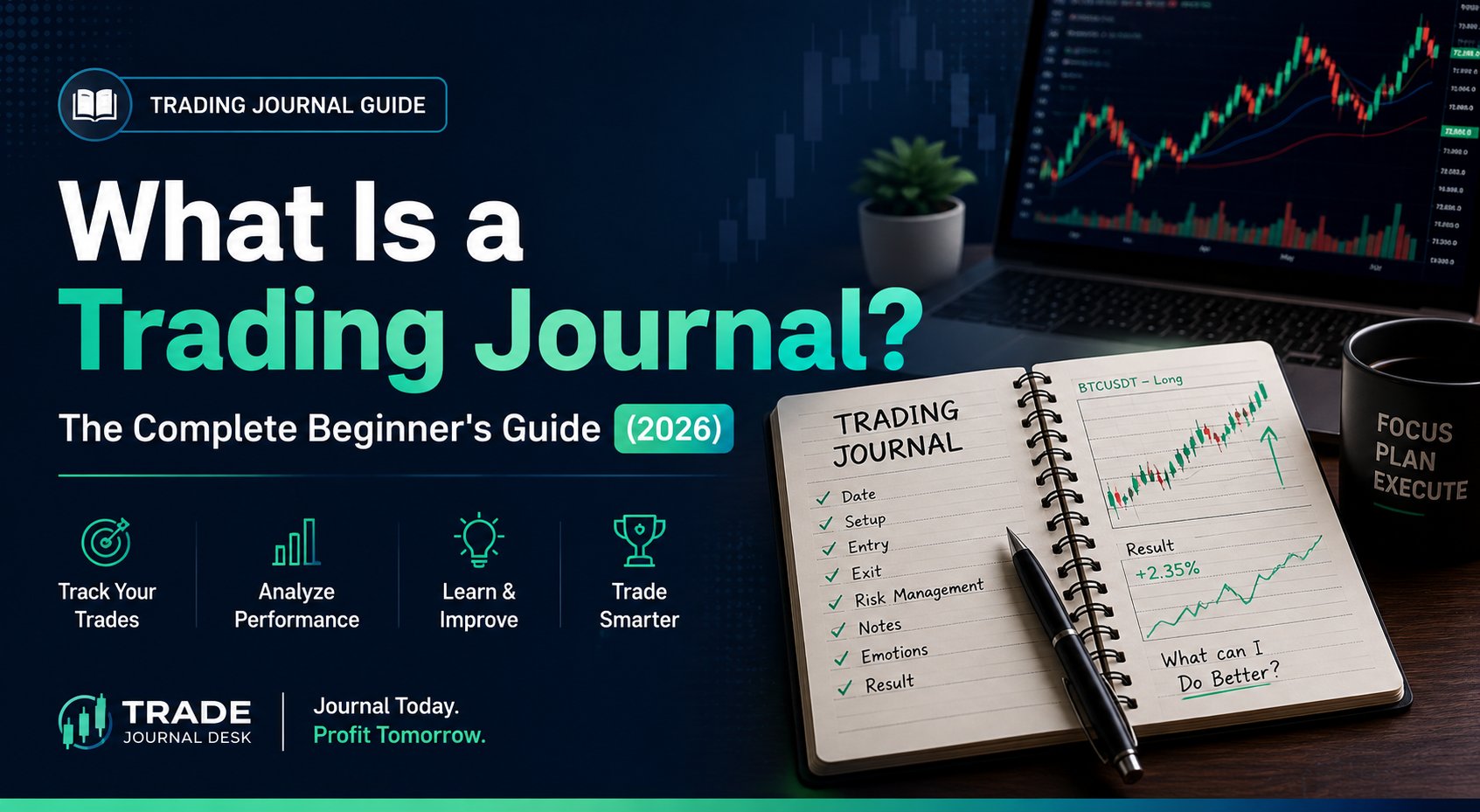
You've placed a few hundred trades this year. Some worked, some didn't, and if someone asked you right now which strategy actually makes you money, could you answer with a number — or would you just have a feeling?
That's the trap most traders live in. You remember the huge winner from March vividly. You remember the gut-punch loss from last Tuesday even more vividly. Everything in between blurs into a general sense of "I'm doing okay" or "the market's been rough lately." Meanwhile, three real questions sit unanswered:
- Which of your setups actually has an edge, and which one you just think has an edge?
- Which specific mistake is costing you the most money — moving your stop, oversizing, or entering too early?
- Why does your win rate swing from 65% one month to 30% the next?
- Why does confidence evaporate after two or three losing trades, even when your strategy hasn't changed at all?
None of those questions can be answered from memory. They can only be answered from data — your own data, recorded trade by trade. That record has a name: a trading journal. This guide covers exactly what one is, why it matters more than almost any indicator you'll ever add to a chart, and how to build one that you'll actually keep using past week two.
- A trading journal records the reasoning behind a trade, not just the result — that's what separates it from a broker statement.
- Most traders need 30–50 logged trades before real patterns emerge.
- The traders who improve fastest review losses in more detail than wins, not less.
- Consistency beats sophistication — a simple journal you actually update beats a perfect template you abandon.
What Is a Trading Journal?
A trading journal is a structured, ongoing record of every trade you take — the market, the entry and exit, the size, the strategy behind it, the outcome, and (critically) your reasoning and state of mind at the time. It's part logbook, part performance report, and part diary, kept for one purpose: so that future-you can look back at past-you's decisions and get objectively better because of it.
The definition sounds simple, but the purpose is where it earns its keep. A trading journal exists to turn trading from a string of disconnected events into a dataset you can analyze. Once your trades live in a structured record instead of scattered across memory and broker statements, you can start asking real questions: Does my strategy actually have positive expectancy? Am I better in the morning session or the afternoon? Does my win rate drop after a loss because I start revenge trading?
This is exactly why professional traders — the ones running prop firm accounts, managing funds, or simply trading for a living — treat journaling as non-negotiable. Professional trading desks review performance data as routinely as they review the market. It's not a nice-to-have habit reserved for people who like spreadsheets; it's treated the same way a pilot treats a flight log or a surgeon treats a case history — as the record that makes improvement possible at all.
If you only remember one sentence from this guide, make it this one: a trading journal is what turns experience into skill. Without one, you don't have ten years of trading experience — you have one year of experience, repeated ten times.
Why Every Trader Needs a Trading Journal
Every argument for journaling eventually comes back to one of six things: discipline, data, psychology, risk, performance, and consistency. Here's how each one plays out in practice.
Discipline
Knowing that every trade gets logged — and that you'll have to write down why you took it — makes you think twice before an impulsive entry. Journaling is quiet accountability. It's much harder to break your own rules when you know you'll have to write the reason down in an hour.
Data
Opinions about your trading are cheap. Data about your trading is not. "I feel like I'm better at longs" is an opinion. "My long trades have a 58% win rate versus 41% on shorts, across 140 trades" is data — and only a journal produces the second sentence.
Psychology
Trading is one of the few skills where your emotional state directly changes your decision quality in real time. A journal that tracks how you felt before and after each trade turns vague feelings like "I've been trading badly lately" into a specific, fixable pattern — like discovering that four of your last five losses happened within 30 minutes of an earlier loss.
Risk
You cannot manage what you don't measure. A journal is the only place where your actual risk per trade, your real drawdown, and your true loss streaks are visible in one place — not scattered across weeks of account statements.
Performance
Your equity curve, your win rate, your profit factor, your average risk-reward ratio — every meaningful performance metric is a byproduct of consistent journaling. Without logged data, "performance review" is just a guess dressed up as a conversation.
Consistency
Markets change. Strategies that worked in a trending market can quietly stop working in a choppy one. A journal is your early-warning system — it shows the decay in a strategy's performance long before your account balance makes it obvious.
Benefits of Keeping a Trading Journal
Put those six reasons into practice and the day-to-day benefits stack up quickly:
| Benefit | What Actually Changes For You |
|---|---|
| Better decision making | You start trading based on logged evidence of what works instead of the last thing that happened to you. |
| Strategy analysis | You can finally see, per strategy, which ones are profitable and which ones just feel exciting to trade. |
| Confidence | Confidence stops depending on your last trade and starts depending on your logged track record. |
| Less emotional trading | Tagging emotions makes destructive patterns (revenge trading, FOMO entries) visible instead of invisible. |
| Improved win rate | Reviewing losing setups repeatedly filters out the trade types that quietly drag your win rate down. |
| Better consistency | You start executing your plan the same way every time, because deviations show up clearly on review. |
| Risk management | Position sizing and stop-loss discipline become measurable habits, not vague intentions. |
| Performance tracking | You get a real equity curve, drawdown history, and profit factor instead of a rough mental estimate. |
What Should a Trading Journal Include?
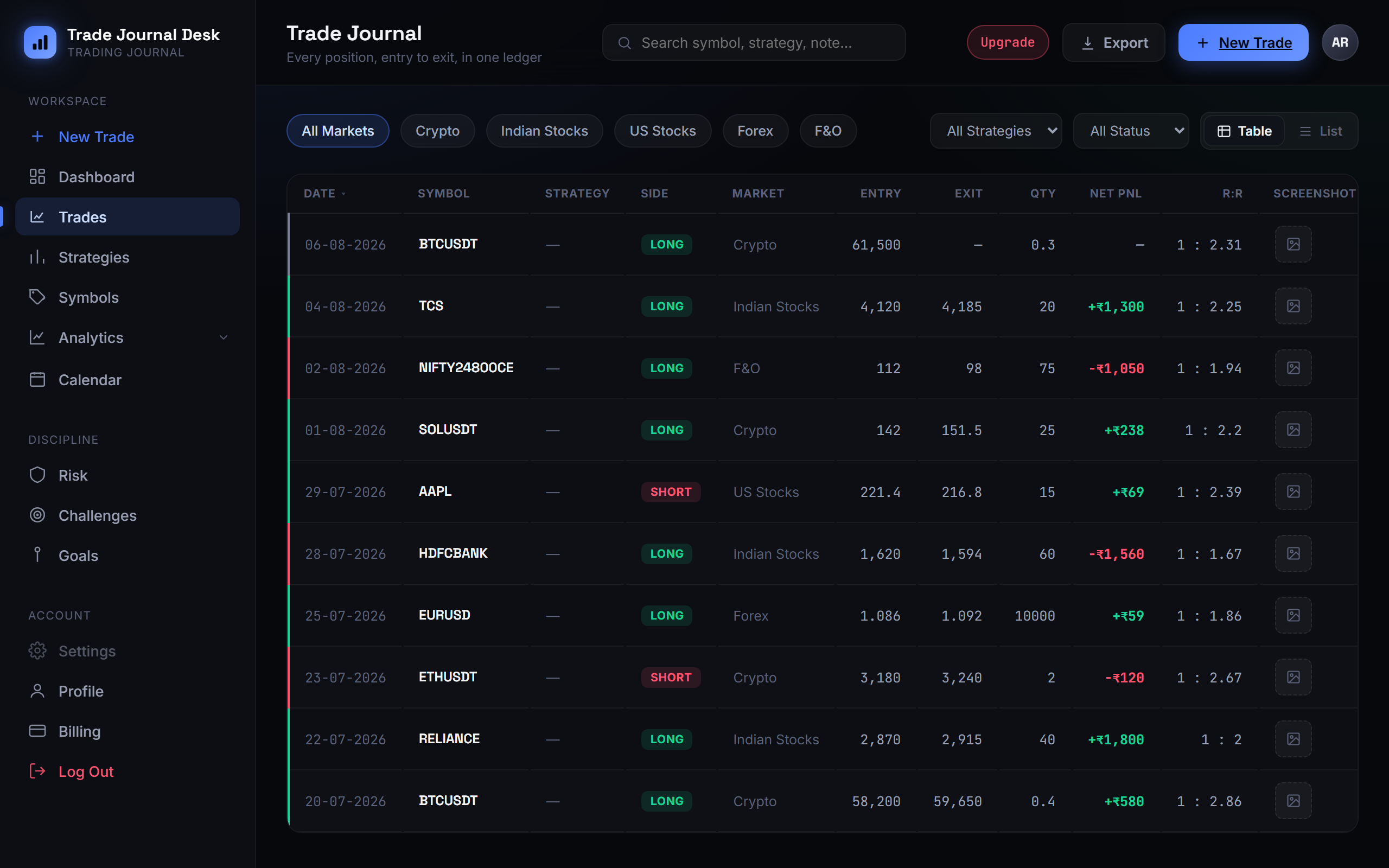
A journal is only as useful as the fields it captures. Too few fields and you lose the context that makes review valuable. Too many and you'll abandon it by week two. Here's the field list we'd recommend for a serious — but sustainable — trading journal:
| Field | Description | Importance | Auto-Calculated? |
|---|---|---|---|
| Date | The trade date, and ideally entry/exit time too | Critical | You enter it |
| Market | Crypto, forex, stocks, commodities, futures & options | High | You enter it |
| Symbol | The exact instrument traded (e.g. BTCUSDT, RELIANCE, EURUSD) | Critical | You enter it |
| Trade Type | Long or short | Critical | You enter it |
| Strategy | Which playbook or setup you were executing | High | You enter it |
| Entry | Your entry price | Critical | You enter it |
| Exit | Your exit price (blank while the trade is still open) | Critical | You enter it |
| Stop Loss | The price that proves your idea wrong | Critical | You enter it |
| Target | Your planned take-profit level | High | You enter it |
| Quantity | Position size or lot size | Critical | You enter it |
| Risk | The amount you stood to lose on the trade | High | ✓ Calculated |
| Reward | The amount you stood to gain on the trade | High | ✓ Calculated |
| Risk-Reward Ratio | Reward divided by risk — the mathematical backbone of your edge | High | ✓ Calculated |
| Fees | Commission, taxes, funding fees, slippage | Medium | You enter it |
| Net PnL | Your actual profit or loss after every cost | Critical | ✓ Calculated |
| Screenshots | Chart images from before, during, and after the trade | High | You attach it |
| Mistakes | Tagged errors — moved stop, oversized, chased entry, ignored plan | High | You tag it |
| Emotion | How you felt before and after the trade | Medium | You tag it |
| Notes | Free-form context — reasoning, market conditions, lessons learned | Medium | You enter it |
| Tags | Custom labels for filtering trades later (e.g. "earnings play", "breakout") | Nice-to-have | You enter it |
The three fields traders skip most often — emotion, mistakes, and screenshots — are usually the three that produce the biggest "aha" moments on review. If you're going to cut corners anywhere, don't cut them here.
Common Trading Journal Mistakes
Starting a journal is easy. Keeping one that's actually useful is where most traders quietly fail. Watch for these six patterns:
Recording only winners. It feels good to log the trades that worked and skip the ones that didn't. It also guarantees your journal will lie to you about your real win rate and edge.
Never reviewing what you log. A journal with 300 entries and zero reviews is just a very detailed diary. The value is entirely in the review, not the logging.
No screenshots. Without a visual record, you'll misremember what the chart actually looked like at entry — almost always in a way that's flattering to your original decision.
Ignoring psychology. Skipping the emotional side of a trade means missing the pattern that's often the actual root cause of your worst losses.
No strategy tracking. If every trade isn't tagged to a strategy, you can never answer "which of my setups actually works" — only "am I up or down overall."
No monthly review. Daily logging without a monthly step-back means you're collecting data but never turning it into a decision.
Trading Journal vs Excel Spreadsheet
Plenty of traders start in a spreadsheet, and there's nothing wrong with that — it's free, flexible, and better than nothing. But it hits a ceiling fast. Here's an honest side-by-side:
| Capability | Trading Journal Software | Excel | Google Sheets | Notebook |
|---|---|---|---|---|
| Automatic PnL & R:R calculation | ✓ | Manual formulas | Manual formulas | ✗ |
| Chart screenshots attached per trade | ✓ | Clunky | Clunky | ✗ |
| Emotion & mistake tagging | ✓ | DIY columns | DIY columns | Free-form |
| Visual analytics & equity curve | ✓ Built-in | Requires pivot charts | Requires charts | ✗ |
| Accessible on your phone mid-trade | ✓ | Awkward | Workable | ✓ |
| Risk of manual formula errors | None | High | High | N/A |
| Backup & loss protection | Cloud-backed | Local file risk | Cloud-backed | Physical risk |
| Learning curve | Low | Medium-High | Medium | None |
None of this means a spreadsheet is a bad place to start. It means that the moment you outgrow it — usually right around the point where you're maintaining formulas instead of reviewing trades — it's worth moving to something purpose-built.
How to Start a Trading Journal
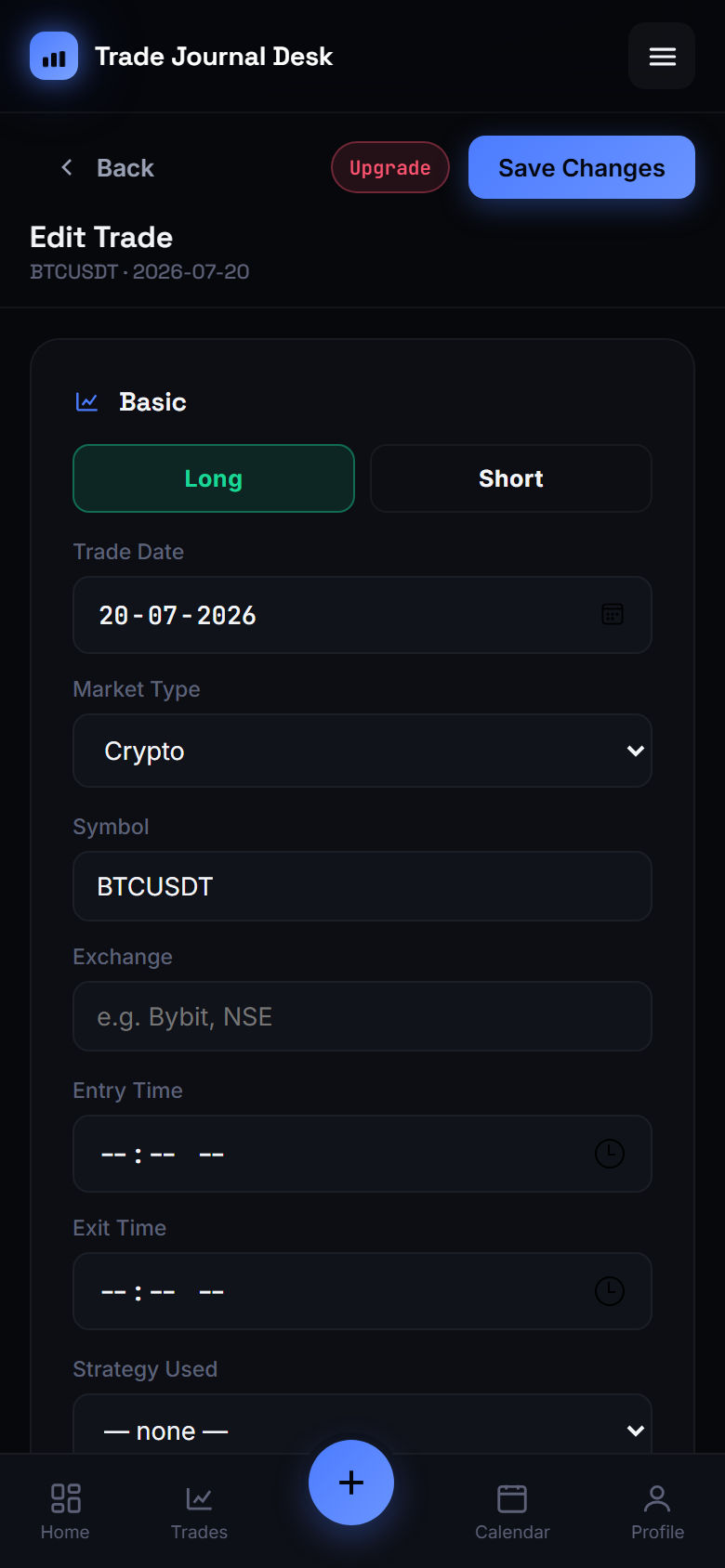
You don't need a perfect system on day one. You need a system you'll still be using in month three. Here's the fastest path there:
Pick your fields before your first trade
Use the field table above as a starting point. Decide now what "done" looks like for a logged trade, so you're not redesigning your journal every week.
Log the trade the moment you close it
Not at the end of the day. Details — your reasoning, your emotional state, what you saw on the chart — fade fast. Logging immediately takes under a minute and captures all of it.
Attach a screenshot every time
One chart image at entry is enough to start. Add exit screenshots once the habit sticks.
Tag the strategy and the emotion
Even a rough guess ("breakout setup", "felt rushed") is far more useful than leaving it blank.
Set a fixed weekly review slot
Same day, same time, every week. Treat it as non-negotiable as the trading itself — it's where the actual improvement happens.
Revisit your field list after 30 trades
By then you'll know which fields you actually use and which ones you're skipping. Cut the ones you skip.
How Often Should You Review Your Journal?
| Cadence | What to Review | Time Needed |
|---|---|---|
| Daily | Quick glance at today's trades — did you follow your plan? | 2–5 minutes |
| Weekly | Every trade from the week, screenshots included, honestly graded | 20–40 minutes |
| Monthly | Win rate, profit factor, best/worst strategy, biggest recurring mistake | 45–60 minutes |
| Quarterly | Overall strategy fit — is your approach still matching current market conditions? | 1–2 hours |
| Yearly | Full performance review — equity curve, drawdown history, goals for next year | Half a day |
The weekly review is the one that matters most and gets skipped most. If you only have time for one recurring review, make it this one.
Trading Psychology and Journaling
Ask any experienced trader what actually separates consistently profitable traders from everyone else, and strategy rarely tops the list. Psychology does. A journal is the single best tool for making your own psychology visible to you — because in the moment, it's nearly impossible to see your own bias.
The patterns a journal exposes
- Fear — exiting winning trades early, consistently, before your target is hit.
- Greed — holding past your plan, moving targets further away mid-trade.
- FOMO — entering trades that weren't part of your plan because the move "was already happening."
- Revenge trading — taking a lower-quality trade within minutes of a loss to "win it back."
- Overtrading — a trade count that spikes on emotionally charged days, not high-opportunity days.
- Patience — waiting for your actual setup instead of a close approximation of it.
- Confidence — sizing and execution that stay consistent regardless of your last two outcomes.
None of these show up clearly in a single trade. They show up in the pattern across twenty or thirty trades — which is exactly what a journal with an emotion field makes visible. Traders who tag "revenge" or "FOMO" honestly for a month are often stunned by how much of their losing streak traces back to two or three recurring emotional triggers.
Risk Management
Risk management sounds abstract until you see it as numbers in your own journal. These are the five figures every serious trader should be able to state without opening a calculator:
- Risk per trade — the percentage of your capital you're willing to lose on any single trade, typically 0.5%–2%.
- Position size — calculated from your stop-loss distance and risk percentage, not from a round-number habit.
- Maximum drawdown — the largest peak-to-trough decline your account has experienced, tracked over time.
- Daily loss limit — a hard stop for the day once losses hit a set amount, to prevent a bad day from becoming a bad month.
- Weekly loss limit — the same discipline applied at a wider timeframe, catching slower bleeds a daily limit alone would miss.
A journal that tracks these limits alongside your trades does something a mental rule never can: it flags the breach the moment it happens, instead of three losing trades later when the damage is already done.
How Professional Traders Use Trading Journals
Walk into any proprietary trading firm and you'll find the same habit repeated across every desk: trades get logged, reviewed, and discussed — often with a mentor or risk manager involved. A few patterns show up consistently among traders who do this for a living:
- They review losses more often than wins, not less — because losses contain more information about what needs to change.
- They track performance per strategy, not just overall, because a profitable month can hide one strategy quietly losing money.
- They separate "a bad trade" from "a losing trade." A well-executed trade that hits its stop loss is not a mistake — an impulsive entry that happens to win is.
- They set hard risk limits before the trading day starts, and their journal is what confirms whether that limit was respected.
- They treat the weekly review as scheduled, recurring work — not something they'll "get to eventually."
None of this requires institutional tools. It requires the habit, applied consistently, with the same structured fields every single time.
How Trade Journal Desk Helps
Everything covered so far works with any journal, including a simple spreadsheet. But this is also exactly the workflow Trade Journal Desk was built around — so it's worth explaining, plainly, how it fits in.
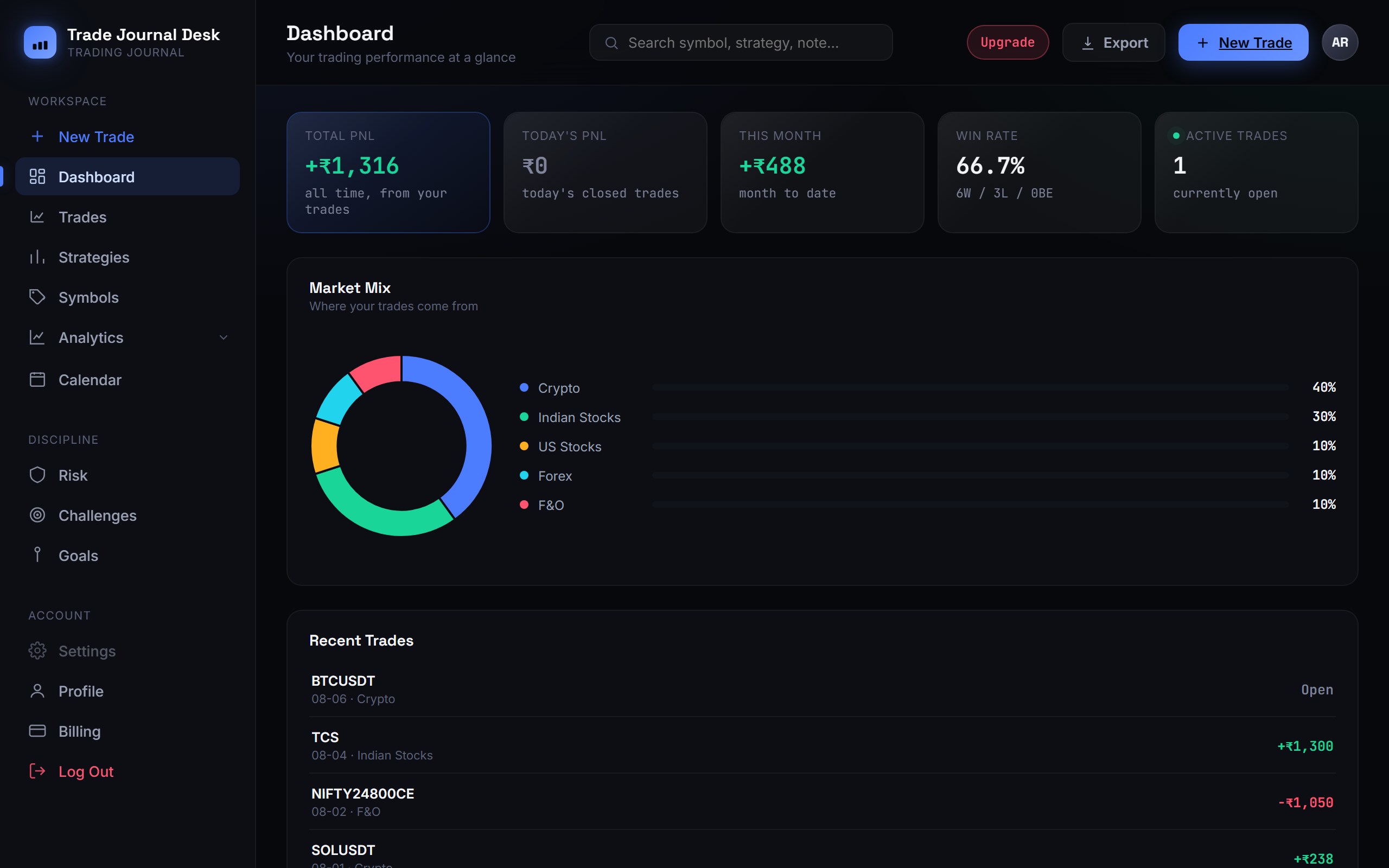
When you log a trade, Trade Journal Desk calculates your net PnL, risk, reward, and risk-reward ratio automatically from your entry, exit, quantity, and side — including commissions, taxes, funding fees, and slippage — so you're never maintaining formulas by hand. Every trade supports pre-trade, during-trade, and post-trade screenshots, plus tagged mistakes and emotions before and after entry, which covers the exact fields this guide flags as the ones traders skip most and need most.
Beyond the trade log itself:
- Strategy & setup tracking — every trade links to a named strategy, so per-strategy performance is a filter away instead of a manual sort.
- Advanced analytics — equity curve, drawdown, win/loss distribution, day-of-week performance, long vs. short breakdown, and holding-time analysis, built from your logged trades automatically.
- Psychology tracking — win rate and PnL broken down by the emotion you tagged, so the fear/greed/FOMO patterns described above become a chart instead of a hunch.
- Calendar view — daily PnL at a glance, useful for spotting the emotional-overtrading pattern where trade count spikes on your worst days.
- Risk management settings — configured capital, risk percentage, and daily/weekly/monthly loss limits, checked against your actual trades in real time.
- Goals & challenges — track progress against personal targets or prop-firm challenge rules (FTMO, FundedNext, and others) inside the same journal.
- Performance dashboard — the exact metrics this guide talks about (win rate, profit factor, average risk-reward) computed the moment you close a trade.
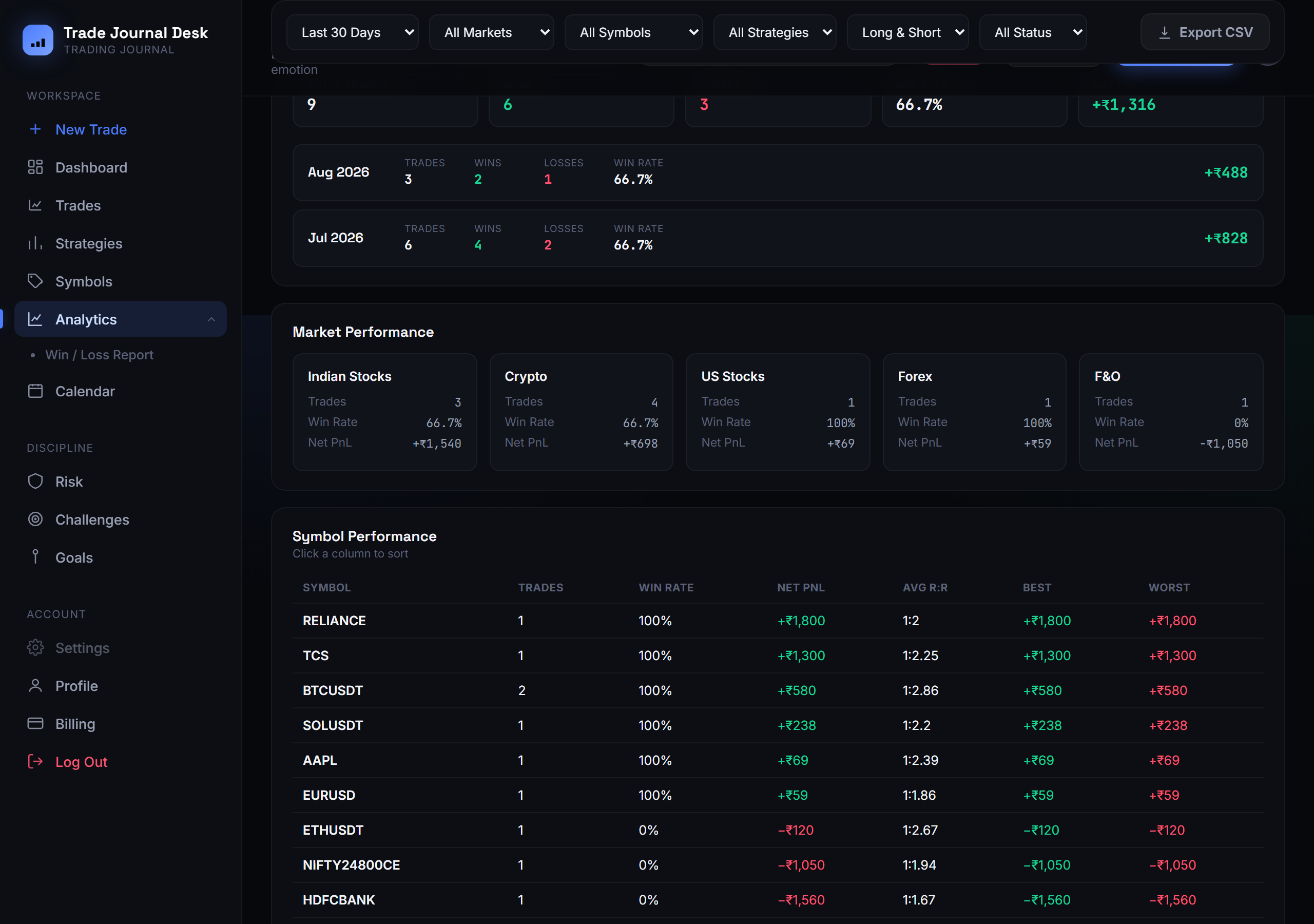
None of it replaces the discipline this guide describes — the habit is still yours to build. What it removes is the friction: the spreadsheet formulas, the manual screenshot filing, the mental math on risk-reward. You focus on the review; it handles the arithmetic. Every trade tells a story — the journal just makes sure you can actually read it back.
Whether you use a notebook, a spreadsheet, or dedicated software, the fields and habits in this guide are what actually move the needle. The tool is secondary — consistency is what compounds.
Frequently Asked Questions
What is a trading journal, in one sentence?
A trading journal is a structured record of every trade you take — entry, exit, size, reasoning, and outcome — kept specifically so you can review it later and make better decisions next time.
Isn't my broker's trade history basically a trading journal?
No. A broker statement tells you what happened financially, but not why. It has no field for your strategy, your reasoning, your emotional state, or the mistake you made. A trading journal captures the decision, not just the result.
What's the difference between a trading journal and a trade log?
A trade log is usually just the numbers — entry, exit, PnL. A trading journal includes the log plus context: strategy, setup, emotion, mistakes, and notes. The log tells you what happened; the journal tells you why.
How long before a trading journal starts showing results?
Most traders see their first useful patterns after 30 to 50 logged trades — enough data to separate a real edge from random variance. Meaningful strategy-level insight usually takes two to three months of consistent logging.
Should complete beginners keep a trading journal from day one?
Yes, and arguably beginners benefit the most. Early mistakes are the cheapest ones you'll ever make, and a journal turns them into a reference file instead of a repeating cycle.
What should I actually write in the notes section of a trade?
Your reasoning for entering, what you expected to happen, what actually happened, and one honest sentence on what you'd do differently. Skip generic notes like "good trade" — they don't teach you anything on review.
Is a spreadsheet good enough, or do I need dedicated trading journal software?
A spreadsheet works for the first few weeks. It starts breaking down once you want automatic PnL and risk-reward calculations, chart screenshots, emotion tagging, and visual analytics — that's where dedicated trading journal software pulls ahead.
How do I journal emotions without it feeling pointless?
Keep it to a single tag per trade — confident, anxious, FOMO, revenge, bored — logged before and after the trade. Over 20-30 trades you'll see a clear pattern between emotional state and outcome, which is the whole point.
What's a good win rate to aim for?
There's no universal number — a 40% win rate with a 3:1 reward-to-risk ratio can be far more profitable than a 70% win rate with a 1:1 ratio. Your journal is what lets you calculate your actual expectancy instead of guessing.
Should I journal losing trades in as much detail as winners?
More detail, if anything. Losing trades are where the real lessons live. Traders who only log wins end up with a journal that flatters them instead of improving them.
How often should I review my trading journal?
A short daily glance, a proper weekly review of every trade, a monthly review of your metrics and strategy performance, and a quarterly step-back to reassess your overall approach.
Can a trading journal help with tax reporting?
It helps enormously as a supporting record — dated entries, exits, quantities, and net PnL per trade — though you should always confirm final figures with your broker's contract notes or a tax professional.
Does journaling work for crypto and forex traders, or just stocks?
It works the same way across every market — crypto, forex, stocks, commodities, and futures & options. The fields you track (entry, exit, risk, emotion, mistake) don't change; only the instrument does.
What is the risk-reward ratio and why does my journal need it?
Risk-reward ratio compares what you stood to lose against what you stood to gain on a trade. Tracking it across your journal reveals whether your strategy is mathematically sound even before you factor in win rate.
How do I stay consistent with journaling when I'm busy?
Log the trade the moment you close it, not at the end of the day — the details are freshest then and it takes under a minute. A journal that lives on your phone removes the last excuse to skip it.
Is Trade Journal Desk free to use?
You can log up to 10 trades for free with full access to analytics, so you can test whether it actually fits your workflow before subscribing to a paid plan.
Can I journal options and futures trades too?
Yes. Futures & options is treated as its own market category, and the same core fields — entry, exit, stop loss, target, risk-reward, and PnL — apply just as they do to a straightforward equity or crypto trade.
Final Thoughts
A trading journal won't fix a broken strategy, and it won't make a losing system profitable. What it does is show you, in plain numbers, exactly what's working and what isn't — which is the only honest starting point for actually getting better. Every professional trader keeps one for a reason: not because it's a nice habit, but because there's no faster way to convert months of screen time into real, repeatable skill.
Start simple. Log the next trade you take — every field, no skipping the uncomfortable ones — and review it honestly at the end of the week. That single habit, repeated for a few months, will teach you more about your own trading than any indicator, course, or signal group ever will.
Keep Exploring
Ready to understand your trading like never before?
Start using Trade Journal Desk and discover why Every Trade Tells a Story.